Portugal's passage to the World Cup knockout stages was secured in the most emotionally turbulent of circumstances, with Gonçalo Ramos's late goal against Croatia providing the decisive moment in a match that embodied everything unpredictable about tournament football. The young striker's finish, arriving in the closing stages after Rafael Leão's creative intervention, proved the difference in a contest that swung wildly between periods of control and chaos. Yet it was not merely the goal itself that will define this encounter in the memory of Portuguese supporters and neutrals alike—it was the VAR controversy that followed, a reminder that even in moments of triumph, the modern game's technological apparatus can inject uncertainty and rancour into celebration. Portugal's qualification represents both a validation of their attacking ambitions and a narrow escape from the kind of group-stage exit that would have constituted a genuine shock given their status as one of Europe's established powers.
Locked pre-kickoff — model v4.2
The Narrative Arc of a Chaotic Contest
The match between Portugal and Croatia unfolded as a study in contrasts, oscillating between periods where one side appeared to have seized control and moments where the narrative shifted with startling speed. Croatia, a nation that has proven itself capable of competing at the highest level despite limited resources, came to compete with the intensity and tactical discipline that has become their hallmark. Portugal, meanwhile, arrived as favourites—a squad brimming with attacking talent and the confidence of a side that had navigated their group with relative comfort. What emerged was neither a straightforward Portuguese victory nor a Croatian upset, but rather a match that tested both teams' resilience and decision-making under pressure. The ebb and flow of possession and territory meant that neither side could establish the kind of sustained dominance that typically characterises knockout football. This unpredictability, while making for compelling viewing, also created the conditions for the dramatic conclusion that would ultimately decide the tie.



Leão's Creativity and Ramos's Clinical Finish
Rafael Leão's involvement in the decisive moment encapsulated the kind of creative spark that Portugal possesses in abundance. The AC Milan winger, operating in an advanced role, demonstrated the technical quality and spatial awareness that has made him one of Europe's most exciting attacking talents. His cross—the kind of delivery that requires both precision and an understanding of where teammates will be positioned—found Gonçalo Ramos in a dangerous area. Ramos, a player who has emerged as a genuine alternative to Portugal's established attacking hierarchy, showed the composure and instinct required to convert a half-chance into a goal. The image of Leão dropping to his knees in celebration spoke to the collective relief and joy of a team that had been pushed closer to the brink than many would have anticipated. For Ramos in particular, this goal represents a significant moment in his international career—a chance to stake a claim for regular involvement in Portugal's knockout campaign and beyond. The finish itself was clinical rather than spectacular, but in tournament football, such moments often prove more valuable than the most aesthetically pleasing strikes.
| # | Team | P | GD | Pts |
|---|---|---|---|---|
| 1 | | 6 | +8 | 14 |
| 1 |  | 6 | +6 | 13 |
| 1 |  | 6 | +14 | 14 |
| 1 |  | 6 | +9 | 16 |
| 1 |  | 6 | +1 | 11 |
VAR's Controversial Intervention
The goal's validation through VAR review introduced an element of tension that threatened to overshadow Portugal's achievement. The technology, introduced ostensibly to eliminate clear and obvious errors, instead became a source of anxiety as officials reviewed the incident from multiple angles. This is the paradox that has come to define VAR's role in modern football: rather than providing definitive clarity, it often generates debate about subjective interpretations of handball, offside, and contact. In this instance, the review process extended the agony for Portuguese supporters and players alike, creating a liminal space where celebration was suspended pending technological confirmation. The eventual decision to award the goal was correct, but the manner in which it was reached—the delay, the uncertainty, the sense that the outcome hung in the balance—exemplified the way VAR has altered the emotional texture of football. For Croatia, the decision represented a bitter pill, another instance where a team's efforts were negated by a moment of fine margins. For Portugal, it was a reprieve, but one that came with the uncomfortable knowledge that fortune had played a role in their progression.
Implications for Portugal's Tournament Trajectory
Portugal's qualification, secured through this dramatic victory, places them among the favourites for the tournament's latter stages. However, the manner of their passage raises questions about their consistency and their ability to dominate matches against well-organised opposition. A truly elite team would have put Croatia away with greater comfort, establishing a commanding position that would have rendered the final moments academic. Instead, Portugal found themselves in a position where a single moment—Ramos's finish, Leão's cross, the VAR decision—determined their fate. This is not necessarily a criticism; tournament football is inherently unpredictable, and the ability to find a way through difficult matches is itself a valuable quality. Nevertheless, as Portugal progresses deeper into the competition, they will face opponents of increasing quality, teams that will not afford them the opportunities to escape by the narrowest of margins. The attacking talent at their disposal—Leão, Ramos, and their established stars—suggests they possess the firepower to compete with anyone. The question is whether they can harness that talent with greater consistency and control.
Looking Ahead: The Road to Glory
Portugal's next challenge will test their mettle against a knockout opponent of unknown identity, but one that will almost certainly represent a step up in difficulty from their group-stage encounters. The experience of this match—the drama, the VAR controversy, the late-game intensity—may prove valuable in preparing them for the pressures of knockout football. Gonçalo Ramos's emergence as a goal-scoring option provides Fernando Santos with tactical flexibility, while Leão's creativity offers a dimension that can unlock defences. The coming weeks will reveal whether this victory represents the beginning of a genuine tournament run or merely a narrow escape that masks underlying vulnerabilities. For now, Portugal can take satisfaction in their progression, but the real test of their credentials lies ahead.

Gonçalo Ramos
Paris Saint Germain
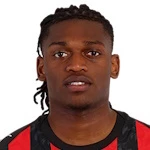
Rafael Leão
AC Milan

