Cristiano Ronaldo has added another chapter to his extraordinary international legacy, becoming the first player in World Cup history to score goals across six different tournaments. The milestone, achieved in Portugal's commanding 5-0 victory on Tuesday, represents not merely a statistical curiosity but a profound testament to longevity, adaptability, and an almost obsessive commitment to excellence that has defined his career across nearly two decades of elite football.
The significance of this achievement cannot be overstated. In an era where physical decline is inevitable and where the demands of international football grow more intense with each passing cycle, Ronaldo's ability to remain a decisive force at the World Cup stage speaks to an exceptional combination of physical maintenance, mental resilience, and tactical intelligence. This is not a player coasting on reputation or appearing in tournaments as a ceremonial figurehead; he remains a genuine threat in front of goal, capable of influencing matches at the sport's highest level when it matters most.
The Rarity of Sustained World Cup Relevance


Scoring at six World Cups is a feat that underscores just how exceptional Ronaldo's career trajectory has been. Most elite strikers enjoy a window of perhaps two or three tournaments where they can be considered genuine contenders for the Golden Boot or key attacking figures for their nations. The physical toll of international football, combined with the natural aging process, typically sees even the greatest players fade from prominence by their mid-thirties. Yet Ronaldo, now in the twilight of his career, continues to find the net on football's grandest stage.

The historical context makes this even more remarkable. Previous generations of world-class forwards—players of genuine pedigree like Pelé, Diego Maradona, and Franz Beckenbauer—never achieved this particular milestone. Ronaldo has now surpassed them in this specific dimension of World Cup history. While direct comparisons across eras are fraught with difficulty, the sheer consistency required to score across six separate tournaments, each separated by four years and each presenting entirely different tactical, physical, and psychological challenges, places Ronaldo in genuinely rarefied air.
| # | Team | P | GD | Pts |
|---|---|---|---|---|
| 1 |  | 3 | +6 | 7 |
| 1 |  | 3 | +5 | 9 |
| 1 |  | 3 | +1 | 5 |
| 1 |  | 3 | +2 | 6 |
| 1 |  | 3 | +1 | 4 |
| 1 |  | 3 | +2 | 6 |
Portugal's Dominant Display and Tactical Context
The 5-0 victory that provided the stage for Ronaldo's historic goal speaks to Portugal's current form and their ambitions in the tournament. A scoreline of that magnitude against any opponent at World Cup level indicates not merely superiority but a comprehensive dominance across all phases of play. For Ronaldo to find the net within this context—rather than being the sole source of attacking threat—suggests that Portugal's attacking infrastructure is functioning at a high level, with multiple creative and finishing threats distributed across the team.
This is an important distinction. Ronaldo's goal-scoring record at international level has sometimes been characterized as dependent on his individual brilliance, a narrative that occasionally obscures the quality of service and tactical support he receives. A 5-0 victory indicates a team performing at peak efficiency, with attacking play flowing through multiple channels. Ronaldo's contribution, while historically significant, sits within a broader context of Portuguese attacking prowess. This suggests that Portugal's chances of progressing deep into the tournament may rest not solely on Ronaldo's individual performances but on the collective strength of their attacking unit.
The Physical and Mental Demands of Longevity
What makes Ronaldo's achievement particularly striking is the physical reality of competing at the highest level across six World Cup cycles. Each tournament demands peak physical conditioning, explosive power, and the kind of recovery capacity that typically diminishes with age. The fact that Ronaldo continues to meet these demands—and continues to deliver in crucial moments—speaks to an almost obsessive approach to physical maintenance and professional discipline.
The mental dimension is equally significant. Younger players often approach World Cups with a sense of novelty and excitement; for Ronaldo, this is his sixth rodeo. The psychological challenge of maintaining hunger, focus, and competitive intensity across multiple tournaments, particularly after experiencing both triumph and disappointment, cannot be underestimated. The ability to remain motivated and sharp after decades at the elite level, after winning numerous individual and collective honours, requires a particular mindset. Ronaldo's continued effectiveness suggests that his competitive drive remains undiminished, that he continues to view each tournament as an opportunity to add to his legacy rather than as a farewell tour.
Legacy and the Broader Narrative
This goal places Ronaldo in a unique historical position. He is no longer simply competing for individual accolades or team success; he is now actively rewriting the record books in ways that may never be matched. The first player to score at six World Cups is a distinction that carries weight precisely because it is so difficult to achieve. Future generations of players will need to match not only Ronaldo's individual talent but also his longevity, consistency, and ability to perform under pressure across multiple decades.
The broader narrative around Ronaldo's career has often centred on his rivalry with Lionel Messi, a comparison that has dominated football discourse for over a decade. Yet achievements like this—scoring at six World Cups—exist in a different category. They are not about head-to-head competition or direct comparison but about pushing the boundaries of what is possible in professional football. Ronaldo is not simply competing against his peers; he is competing against history itself, against the accumulated records of every player who has ever represented their nation at the World Cup.
Looking Forward: Portugal's Tournament Ambitions
As Portugal progresses through the tournament, Ronaldo's continued presence as a goal-scoring threat will be crucial to their chances of winning the competition. While the 5-0 victory demonstrates that Portugal possess attacking depth, the knockout stages of the World Cup typically demand the kind of clinical finishing and big-game experience that Ronaldo provides. His ability to perform in high-pressure situations, combined with his newfound status as a record-breaker, may provide additional psychological momentum for the Portuguese team.
The question now becomes whether Ronaldo can build on this milestone and contribute meaningfully to Portugal's push for the trophy. A World Cup victory at this stage of his career would represent the ultimate validation of his longevity and would cement his legacy in ways that individual records, however impressive, cannot quite achieve. For Portugal, having a player of Ronaldo's experience and proven tournament pedigree remains a significant asset as they navigate the increasingly demanding stages of the competition.
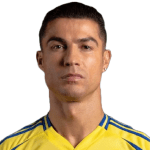
Cristiano Ronaldo
Al-Nassr


