Portugal's captain Cristiano Ronaldo converted from the penalty spot to draw his side level against Croatia in a tightly contested round of 32 encounter in Toronto, a moment that underscored both his enduring importance to the national team and the competitive intensity of knockout football at this stage of the tournament. The goal, arriving at a critical juncture, kept Portugal's hopes alive in a match that had threatened to slip away, demonstrating once again why Ronaldo remains the focal point of his country's attacking ambitions despite the passage of time and the emergence of younger talent around him. The penalty itself was clinical—a hallmark of Ronaldo's vast experience—yet the broader context of the match revealed deeper questions about Portugal's tactical resilience and their capacity to sustain pressure against a well-organised Croatian side determined to upset the established order.
The Moment and Its Immediate Context
The penalty conversion arrived as a turning point in a match that had been shaped by Croatia's disciplined defensive approach and Portugal's struggles to break through the middle third with their customary fluidity. Ronaldo's conversion from twelve yards was executed with the precision expected of a player who has spent two decades at the highest level, his technique and composure evident in the execution. The significance of the goal extended beyond the mere mathematics of the scoreline; it represented a psychological reset for Portugal, who had been forced into a reactive posture for much of the first half. Croatia, a team with genuine pedigree in knockout competitions, had imposed their physical template on the match, and Portugal's midfield had found themselves frequently dispossessed or forced into hurried distribution. The penalty offered respite and renewed belief, transforming what had threatened to become a narrative of Portuguese underperformance into one of character and comeback potential.



Ronaldo's Continued Centrality to Portugal's Project
At this stage of his career, Ronaldo's role within the Portugal setup has evolved from that of a dominant, all-action forward into something more nuanced: a focal point, a penalty-taker, and a leader whose presence alone carries psychological weight. The penalty conversion exemplified this reality. While his overall influence on the match may have been constrained by Croatia's defensive organisation, his ability to deliver in moments of genuine pressure remains undiminished. This is not to suggest that Ronaldo is merely a penalty specialist—his movement, positioning, and reading of the game remain sharp—but rather that his value to Portugal increasingly concentrates around decisive moments and leadership. The broader Portugal squad contains younger, more explosive attacking talent, yet the captain's experience and mentality in high-stakes situations remain irreplaceable assets. His conversion rate from the spot is among the elite globally, and in knockout football, where margins are razor-thin and momentum shifts rapidly, such reliability becomes almost priceless.
| # | Team | P | GD | Pts |
|---|---|---|---|---|
| 1 |  | 3 | +6 | 7 |
| 1 |  | 3 | +5 | 9 |
| 1 |  | 3 | +1 | 5 |
| 1 |  | 3 | +2 | 6 |
| 1 |  | 3 | +1 | 4 |
| 1 | | 3 | +2 | 6 |
Croatia's Defensive Resilience and the Broader Match Dynamic
Croatia's approach to the match reflected their understanding of Portugal's strengths and their own need to remain compact and organised. The Balkan nation has built a reputation on tactical discipline and collective effort, qualities that have served them well in previous tournament campaigns. By restricting space in midfield and forcing Portugal into wide areas, Croatia had created a match of limited fluency, one in which neither side could impose their preferred rhythm. The penalty that Ronaldo converted represented a breach in that defensive structure—whether through a genuine foul or a marginal decision, it offered Portugal an opportunity to reset the contest. This dynamic is instructive: even well-organised defensive units cannot sustain perfection across ninety minutes, and in knockout football, a single lapse or a moment of referee interpretation can alter the trajectory entirely. Croatia's response to being drawn level would become crucial; teams that have invested so heavily in defensive solidity sometimes struggle to recover psychologically when that structure is breached.
Tournament Context and the Road Ahead
The round of 32 represents a threshold moment in any tournament structure. Teams that have navigated the group stage now face opponents of genuine quality, and the margin for error shrinks considerably. Portugal's ability to recover from a deficit—or at least to avoid falling behind—speaks to their tournament credentials, yet the match against Croatia also exposed vulnerabilities that more ruthless opponents might exploit. The penalty conversion kept their campaign alive, but the broader performance suggested that Portugal would need to improve their control of the midfield and their ability to transition from defence to attack with greater efficiency. For Ronaldo personally, the goal added to his tournament tally and reinforced his status as a player capable of delivering when it matters most. Yet the match also illustrated the reality that even the greatest players cannot single-handedly overcome tactical deficiencies or collective underperformance. Portugal's progression would depend not merely on Ronaldo's moments of brilliance but on the collective improvement of the team's shape, intensity, and decision-making in possession.
As Portugal and Croatia prepared for the remainder of the match, the narrative had shifted from one of potential Croatian upset to one of genuine competition between two sides with legitimate claims to progress further. Ronaldo's penalty had levelled the scoreline but also levelled the psychological stakes, transforming what had been a match tilted in Croatia's favour into a genuine contest. The closing stages would reveal which team possessed the greater reserves of energy, tactical flexibility, and composure under pressure—qualities that separate tournament winners from early exits.
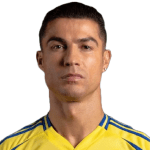
Cristiano Ronaldo
Al-Nassr


