Cristiano Ronaldo has delivered the most emphatic possible riposte to mounting criticism of his relevance at international level, becoming the first player in World Cup history to score across six separate tournaments. The Portugal forward's latest milestone, achieved at an age when most elite athletes have long since retired from the global stage, represents not merely a statistical curiosity but a profound statement about longevity, hunger, and the refusal to accept diminishment.
The goal arrives at a moment when Ronaldo's place in Portugal's plans had become genuinely contested. Questions about his fitness, his tactical fit in modern pressing systems, and whether his presence might actually constrain his team's attacking fluidity had grown louder through the qualifying campaign and into the tournament itself. Rival pundits, former players, and even some sections of the Portuguese media had begun openly debating whether sentiment should override pragmatism. Ronaldo's response—etched into the record books as a historic first—transforms that conversation entirely. He has not merely answered the critics; he has rendered their arguments temporarily obsolete through the only language that truly matters in football: goals.
The Weight of History and Expectation


Ronaldo's journey across six World Cup tournaments spans nearly two decades of international football at the highest level. His first World Cup goal came in 2006 in Germany, when he was a precocious 21-year-old winger at Manchester United, still establishing himself as a global force. Since then, he has competed in 2010, 2014, 2018, 2022, and now 2026, a continuity of presence that is itself remarkable given the physical and mental demands of elite sport. Few players have maintained the intensity, fitness, and competitive edge required to remain relevant across such a span. Pelé, Maradona, and Messi all faded from the international stage before reaching this particular milestone, making Ronaldo's achievement genuinely singular.

The historical context matters because it underscores what makes this moment significant beyond mere statistics. Ronaldo is not simply accumulating records in a vacuum; he is doing so whilst competing against younger, fresher athletes in a sport that has become faster, more athletic, and more demanding with each passing year. The tactical evolution of international football—the emphasis on pressing, the reduction of space, the premium placed on explosive acceleration—should theoretically disadvantage a player in his late thirties. That Ronaldo continues to find the net anyway speaks to an almost obsessive commitment to adaptation and self-maintenance.
| # | Team | P | GD | Pts |
|---|---|---|---|---|
| 1 |  | 3 | +6 | 7 |
| 1 |  | 3 | +5 | 9 |
| 1 |  | 3 | +1 | 5 |
| 1 |  | 3 | +2 | 6 |
| 1 |  | 3 | +1 | 4 |
| 1 |  | 3 | +2 | 6 |
The Tactical and Psychological Dimensions
Portugal's approach to this tournament has been shaped partly by the question of how to accommodate Ronaldo without compromising the team's structural integrity. Younger, more mobile forwards like Gonçalo Ramos have offered different qualities—pressing intensity, positional flexibility, the ability to operate in tighter spaces. The debate was never truly about Ronaldo's technical ability; it was about whether his presence created more problems than it solved in a modern system. His goal answers that question by demonstrating that experience, positioning, and clinical finishing remain potent weapons even in an era obsessed with youth and athleticism.
Psychologically, this moment carries weight for Portugal as a collective unit. A team that has won a major tournament (Euro 2016) and reached a World Cup semi-final (2022) carries expectations that can become burdensome. Ronaldo's presence—and now his goal—provides a psychological anchor. His teammates know they are playing alongside a player who has won everything, faced every conceivable pressure, and responded with consistency. That intangible quality, the sense that a leader has "been there," can be as valuable as any tactical instruction. The goal reinforces that narrative: Ronaldo is not a passenger; he remains a difference-maker.
The Broader Narrative of Longevity
What distinguishes Ronaldo's achievement from mere longevity is the quality maintained across the span. He is not simply present at six World Cups; he is scoring at six World Cups. That distinction is crucial. Many players have competed across multiple tournaments; far fewer have remained productive across such a timeline. The physical toll of international football—the travel, the compressed schedules, the intensity of knockout competition—typically extracts a price that manifests in declining output. Ronaldo's ability to buck that trend speaks to an almost obsessive approach to fitness, recovery, and mental preparation.
The broader implications extend beyond Ronaldo himself. His continued excellence at this level challenges some of the conventional wisdom about athletic aging. Sports science has made enormous strides in extending careers, but individual commitment remains paramount. Ronaldo's example will inevitably influence how clubs and national teams approach player management, recovery protocols, and the question of when to transition aging stars out of the system. If a player can remain genuinely productive into his late thirties at the highest level, the calculus around squad planning shifts accordingly.
The Silencing of Doubt and the Vindication of Belief
The timing of this goal—arriving when doubt was loudest—carries a narrative power that transcends statistics. Ronaldo has always thrived on adversity, on the sense that he has something to prove. His career has been punctuated by moments where external pressure or criticism has preceded a response of almost theatrical defiance. This goal fits that pattern perfectly. It is not merely a goal; it is a statement, a reassertion of relevance, a refutation of the notion that age and changing football have finally caught up with him.
For Portugal, the implications are significant. If Ronaldo can deliver at this level, the team's attacking options become more varied and potent. Opponents cannot simply focus on neutralising younger forwards; they must account for a player whose experience and positioning sense remain elite. That complexity in defensive planning can create space for teammates, can generate the kind of numerical advantages that decide tight matches. Ronaldo's goal, therefore, benefits not only his own legacy but potentially Portugal's tournament prospects.
What Comes Next
The question now is whether this goal represents a genuine resurgence or a final flourish. Ronaldo will be 41 by the time of the next World Cup in 2030; the likelihood of a seventh tournament appearance is minimal, and the prospect of a seventh goal even more remote. This moment, therefore, carries a sense of finality. It is almost certainly the last time Ronaldo will add to this particular record. That knowledge lends the achievement additional poignancy—it is not a stepping stone but a destination, a final punctuation mark on an extraordinary international career.
For Portugal, the immediate focus shifts to whether Ronaldo's goal can catalyse a deeper tournament run. A single goal, however historic, does not guarantee success; Portugal must build on this moment, must convert the psychological boost into consistent performances. But the narrative has shifted. Ronaldo is no longer a question mark; he is a proven asset, a player who has answered the doubters with the only response that truly matters. In football, as in life, actions speak louder than words. Ronaldo has spoken.
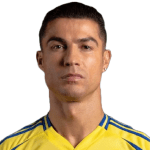
Cristiano Ronaldo
Al-Nassr


